What Are 3 Ways That Art May Function According the Dennis Sporre


Pollen is a powdery substance produced past seed plants. It consists of pollen grains (highly reduced microgametophytes), which produce male gametes (sperm cells). Pollen grains have a hard coat made of sporopollenin that protects the gametophytes during the procedure of their movement from the stamens to the pistil of flowering plants, or from the male cone to the female cone of gymnosperms. If pollen lands on a uniform pistil or female person cone, information technology germinates, producing a pollen tube that transfers the sperm to the ovule containing the female gametophyte. Individual pollen grains are pocket-size plenty to crave magnification to see detail. The study of pollen is called palynology and is highly useful in paleoecology, paleontology, archaeology, and forensics. Pollen in plants is used for transferring haploid male genetic material from the anther of a single flower to the stigma of another in cross-pollination.[i] In a case of cocky-pollination, this process takes place from the anther of a flower to the stigma of the same flower.[1]
Pollen is infrequently used as food and nutrient supplement. Considering of agronomical practices, it is ofttimes contaminated by agricultural pesticides.[2]
Structure and formation [edit]
Pollen itself is not the male gamete.[three] It is a gametophyte, something that could be considered an entire organism, which then produces the male gamete. Each pollen grain contains vegetative (non-reproductive) cells (only a single cell in most flowering plants only several in other seed plants) and a generative (reproductive) cell. In flowering plants the vegetative tube cell produces the pollen tube, and the generative cell divides to form the two sperm nuclei.
-
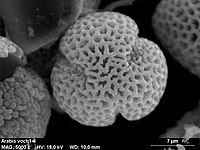
Arabis pollen has three colpi and prominent surface structure.
-

Apple pollen under microscopy
Formation [edit]
Pollen is produced in the microsporangia in the male cone of a conifer or other gymnosperm or in the anthers of an angiosperm flower. Pollen grains come up in a broad variety of shapes, sizes, and surface markings characteristic of the species (see electron micrograph, right). Pollen grains of pines, firs, and spruces are winged. The smallest pollen grain, that of the forget-me-non (Myosotis spp.),[ which? ] is 2.5-five µm (0.005 mm) in bore.[4] Corn pollen grains are large, well-nigh xc–100 µm.[5] About grass pollen is effectually 20-25 µm.[half dozen]

Pollen microspores of Lycopersicon esculentum at coenocytic tetrad stage of development observed through oil immersion microscope; the chromosomes of what volition become four pollen grains can be seen.
In angiosperms, during flower development the anther is equanimous of a mass of cells that appear undifferentiated, except for a partially differentiated dermis. As the flower develops, four groups of sporogenous cells form inside the anther. The fertile sporogenous cells are surrounded by layers of sterile cells that abound into the wall of the pollen sac. Some of the cells grow into nutritive cells that supply nutrition for the microspores that form by meiotic division from the sporogenous cells.
In a process called microsporogenesis, iv haploid microspores are produced from each diploid sporogenous cell (microsporocyte, pollen mother prison cell or meiocyte), later on meiotic division. Subsequently the germination of the iv microspores, which are contained by callose walls, the development of the pollen grain walls begins. The callose wall is broken down by an enzyme called callase and the freed pollen grains abound in size and develop their characteristic shape and class a resistant outer wall called the exine and an inner wall chosen the intine. The exine is what is preserved in the fossil record. Two basic types of microsporogenesis are recognised, simultaneous and successive. In simultaneous microsporogenesis meiotic steps I and II are completed earlier cytokinesis, whereas in successive microsporogenesis cytokinesis follows. While there may be a continuum with intermediate forms, the blazon of microsporogenesis has systematic significance. The predominant form amidst the monocots is successive, just there are important exceptions.[vii]
During microgametogenesis, the unicellular microspores undergo mitosis and develop into mature microgametophytes containing the gametes.[eight] In some flowering plants,[ which? ] germination of the pollen grain may brainstorm even earlier it leaves the microsporangium, with the generative cell forming the two sperm cells.
Structure [edit]
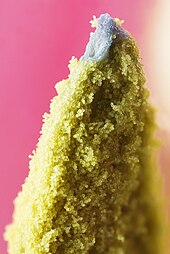
Tulip anther with many grains of pollen
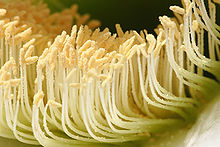
Closeup prototype of a cactus bloom and its stamens
Except in the case of some submerged aquatic plants, the mature pollen grain has a double wall. The vegetative and generative cells are surrounded by a thin fragile wall of unaltered cellulose chosen the endospore or intine, and a tough resistant outer cuticularized wall composed largely of sporopollenin chosen the exospore or exine. The exine frequently bears spines or warts, or is variously sculptured, and the character of the markings is oft of value for identifying genus, species, or even cultivar or individual. The spines may be less than a micron in length (spinulus, plural spinuli) referred to as spinulose (scabrate), or longer than a micron (echina, echinae) referred to as echinate. Various terms also draw the sculpturing such equally reticulate, a net like appearance consisting of elements (murus, muri) separated from each other by a lumen (plural lumina). These reticulations may also exist referred to every bit brochi.
The pollen wall protects the sperm while the pollen grain is moving from the anther to the stigma; it protects the vital genetic material from drying out and solar radiations. The pollen grain surface is covered with waxes and proteins, which are held in place by structures called sculpture elements on the surface of the grain. The outer pollen wall, which prevents the pollen grain from shrinking and crushing the genetic material during desiccation, is equanimous of 2 layers. These two layers are the tectum and the foot layer, which is just above the intine. The tectum and pes layer are separated by a region called the columella, which is composed of strengthening rods. The outer wall is constructed with a resistant biopolymer called sporopollenin.
Pollen apertures are regions of the pollen wall that may involve exine thinning or a significant reduction in exine thickness.[9] They allow shrinking and swelling of the grain acquired by changes in moisture content. The process of shrinking the grain is chosen harmomegathy.[10] Elongated apertures or furrows in the pollen grain are called colpi (atypical: colpus) or sulci (singular: sulcus). Apertures that are more circular are called pores. Colpi, sulci and pores are major features in the identification of classes of pollen.[xi] Pollen may be referred to as inaperturate (apertures absent) or aperturate (apertures present). The discontinuity may have a chapeau (operculum), hence is described as operculate.[12] However the term inaperturate covers a broad range of morphological types, such as functionally inaperturate (cryptoaperturate) and omniaperturate.[seven] Inaperaturate pollen grains often have thin walls, which facilitates pollen tube germination at any position.[9] Terms such as uniaperturate and triaperturate refer to the number of apertures present (one and iii respectively). Spiraperturate refers to ane or more than apertures being spirally shaped.
The orientation of furrows (relative to the original tetrad of microspores) classifies the pollen as sulcate or colpate. Sulcate pollen has a furrow beyond the middle of what was the outer face when the pollen grain was in its tetrad.[thirteen] If the pollen has simply a single sulcus, it is described every bit monosulcate, has ii sulci, equally bisulcate, or more, every bit polysulcate.[14] [15] Colpate pollen has furrows other than across the center of the outer faces, and similarly may be described as polycolpate if more than two. Syncolpate pollen grains have two or more than colpi that are fused at the ends.[16] [13] Eudicots accept pollen with three colpi (tricolpate) or with shapes that are evolutionarily derived from tricolpate pollen.[17] The evolutionary trend in plants has been from monosulcate to polycolpate or polyporate pollen.[13]
Additionally, gymnosperm pollen grains frequently have air bladders, or vesicles, called sacci. The sacci are non actually balloons, but are sponge-like, and increase the buoyancy of the pollen grain and help go on it aloft in the wind, as most gymnosperms are anemophilous. Pollen can exist monosaccate, (containing one saccus) or bisaccate (containing two sacci). Modern pino, spruce, and yellowwood copse all produce saccate pollen.[eighteen]
Pollination [edit]
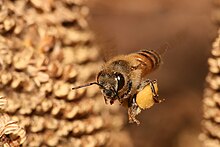

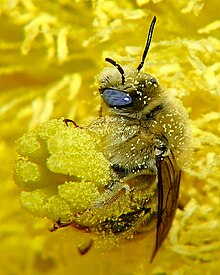
The transfer of pollen grains to the female reproductive structure ( pistil in angiosperms) is called pollination. This transfer can be mediated by the wind, in which case the plant is described as anemophilous (literally wind-loving). Anemophilous plants typically produce not bad quantities of very lightweight pollen grains, sometimes with air-sacs. Not-flowering seed plants (e.g., pine trees) are characteristically anemophilous. Anemophilous flowering plants more often than not have camouflaged flowers. Entomophilous (literally insect-loving) plants produce pollen that is relatively heavy, sticky and protein-rich, for dispersal by insect pollinators attracted to their flowers. Many insects and some mites are specialized to feed on pollen, and are called palynivores.
In non-flowering seed plants, pollen germinates in the pollen chamber, located beneath the micropyle, underneath the integuments of the ovule. A pollen tube is produced, which grows into the nucellus to provide nutrients for the developing sperm cells. Sperm cells of Pinophyta and Gnetophyta are without flagella, and are carried by the pollen tube, while those of Cycadophyta and Ginkgophyta take many flagella.
When placed on the stigma of a flowering plant, under favorable circumstances, a pollen grain puts along a pollen tube, which grows downwardly the tissue of the manner to the ovary, and makes its style along the placenta, guided by projections or hairs, to the micropyle of an ovule. The nucleus of the tube jail cell has meanwhile passed into the tube, as does besides the generative nucleus, which divides (if it hasn't already) to form ii sperm cells. The sperm cells are carried to their destination in the tip of the pollen tube. Double-strand breaks in DNA that ascend during pollen tube growth appear to be efficiently repaired in the generative cell that carries the male genomic data to exist passed on to the next plant generation.[19] However, the vegetative cell that is responsible for tube elongation appears to lack this Dna repair adequacy.[19]
In the fossil record [edit]
Pollen's sporopollenin outer sheath affords it some resistance to the rigours of the fossilisation process that destroy weaker objects; it is as well produced in huge quantities. There is an extensive fossil record of pollen grains, oftentimes disassociated from their parent plant. The bailiwick of palynology is devoted to the study of pollen, which can be used both for biostratigraphy and to gain data most the abundance and diversity of plants alive — which can itself yield of import information well-nigh paleoclimates. Also, pollen assay has been widely used for reconstructing by changes in vegetation and their associated drivers.[20] Pollen is first plant in the fossil record in the late Devonian period,[21] [22] but at that time it is duplicate from spores.[21] It increases in affluence until the present day.
Allergy to pollen [edit]
Nasal allergy to pollen is chosen pollinosis, and allergy specifically to grass pollen is called hay fever. Generally, pollens that crusade allergies are those of anemophilous plants (pollen is dispersed by air currents.) Such plants produce large quantities of lightweight pollen (considering wind dispersal is random and the likelihood of one pollen grain landing on another flower is small), which can exist carried for not bad distances and are easily inhaled, bringing it into contact with the sensitive nasal passages.
Pollen allergies are common in polar and temperate climate zones, where product of pollen is seasonal. In the tropics pollen production varies less by the flavor, and allergic reactions less. In northern Europe, mutual pollens for allergies are those of birch and alder, and in belatedly summertime wormwood and different forms of hay. Grass pollen is also associated with asthma exacerbations in some people, a phenomenon termed thunderstorm asthma.[23]
In the US, people often mistakenly blame the conspicuous goldenrod flower for allergies. Since this plant is entomophilous (its pollen is dispersed past animals), its heavy, sticky pollen does non become independently airborne. Most late summer and fall pollen allergies are probably caused past ragweed, a widespread anemophilous plant.[24]
Arizona was in one case regarded every bit a haven for people with pollen allergies, although several ragweed species abound in the desert. However, as suburbs grew and people began establishing irrigated lawns and gardens, more irritating species of ragweed gained a foothold and Arizona lost its claim of liberty from hay fever.
Anemophilous bound blooming plants such equally oak, birch, hickory, pecan, and early summer grasses may as well induce pollen allergies. Most cultivated plants with showy flowers are entomophilous and do not cause pollen allergies.
Symptoms of pollen allergy include sneezing, itchy, or runny nose, nasal congestion, ruby, itchy, and watery eyes. Substances, including pollen, that cause allergies can trigger asthma. A study establish a 54% increased chance of asthma attacks when exposed to pollen.[25]
The number of people in the United States afflicted by hay fever is between 20 and 40 one thousand thousand, including effectually six.1 million children[26] [27] and such allergy has proven to be the well-nigh frequent allergic response in the nation. Hay fever affects about 20% of Canadians and the prevalence is increasing.[28] There are certain evidential suggestions pointing out hay fever and similar allergies to be of hereditary origin. Individuals who suffer from eczema or are asthmatic tend to be more susceptible to developing long-term hay fever.[29]
Since 1990, pollen seasons take gotten longer and more pollen-filled, and climatic change is responsible, according to a new report.[30] The researchers attributed roughly half of the lengthening pollen seasons and 8% of the tendency in pollen concentrations to climate changes driven by act.[31]
In Denmark, decades of rising temperatures cause pollen to announced before and in greater numbers, besides as introduction of new species such as ragweed.[32]
The nearly efficient way to handle a pollen allergy is by preventing contact with the fabric. Individuals carrying the disquiet may at first believe that they have a elementary summer common cold, but hay fever becomes more axiomatic when the credible common cold does not disappear. The confirmation of hay fever tin can be obtained after examination past a general physician.[33]
Handling [edit]
Antihistamines are effective at treating mild cases of pollinosis; this type of non-prescribed drugs includes loratadine, cetirizine and chlorpheniramine. They do not prevent the discharge of histamine, but it has been proven that they practice foreclose a part of the chain reaction activated by this biogenic amine, which considerably lowers hay fever symptoms.
Decongestants tin can exist administered in different ways such as tablets and nasal sprays.
Allergy immunotherapy (AIT) handling involves administering doses of allergens to accustom the body to pollen, thereby inducing specific long-term tolerance.[34] Allergy immunotherapy can be administered orally (as sublingual tablets or sublingual drops), or by injections under the peel (subcutaneous). Discovered past Leonard Noon and John Freeman in 1911, allergy immunotherapy represents the simply causative treatment for respiratory allergies.
Nutrition [edit]
Most major classes of predatory and parasitic arthropods contain species that eat pollen, despite the common perception that bees are the primary pollen-consuming arthropod group. Many Hymenoptera other than bees consume pollen as adults, though but a small number feed on pollen every bit larvae (including some emmet larvae). Spiders are unremarkably considered carnivores merely pollen is an of import source of food for several species, specially for spiderlings, which catch pollen on their webs. It is non clear how spiderlings manage to swallow pollen however, since their mouths are not large plenty to consume pollen grains.[ citation needed ] Some predatory mites as well feed on pollen, with some species being able to subsist solely on pollen, such as Euseius tularensis, which feeds on the pollen of dozens of plant species. Members of some beetle families such as Mordellidae and Melyridae feed almost exclusively on pollen every bit adults, while various lineages within larger families such as Curculionidae, Chrysomelidae, Cerambycidae, and Scarabaeidae are pollen specialists even though most members of their families are not (e.k., simply 36 of 40,000 species of basis beetles, which are typically predatory, accept been shown to eat pollen—but this is idea to be a severe underestimate as the feeding habits are only known for 1,000 species). Similarly, Ladybird beetles mainly eat insects, but many species also swallow pollen, as either part or all of their nutrition. Hemiptera are more often than not herbivores or omnivores but pollen feeding is known (and has merely been well studied in the Anthocoridae). Many adult flies, especially Syrphidae, feed on pollen, and 3 UK syrphid species feed strictly on pollen (syrphids, like all flies, cannot eat pollen direct due to the structure of their mouthparts, but can swallow pollen contents that are dissolved in a fluid).[35] Some species of mucus, including Fomes fomentarius, are able to break down grains of pollen as a secondary nutrition source that is particularly high in nitrogen.[36] Pollen may be valuable diet supplement for detritivores, providing them with nutrients needed for growth, development and maturation.[37] It was suggested that obtaining nutrients from pollen, deposited on the forest flooring during periods of pollen rains, allows fungi to decompose nutritionally deficient litter.[37]
Some species of Heliconius butterflies swallow pollen as adults, which appears to be a valuable nutrient source, and these species are more distasteful to predators than the not-pollen consuming species.[38] [39]
Although bats, butterflies and hummingbirds are not pollen eaters per se, their consumption of nectar in flowers is an important aspect of the pollination process.
In humans [edit]
Bee pollen for human consumption is marketed as a food ingredient and as a dietary supplement. The largest elective is carbohydrates, with protein content ranging from 7 to 35 pct depending on the found species nerveless by bees.[40]
Dearest produced by bees from natural sources contains pollen derived p-coumaric acrid,[41] an antioxidant and natural bactericide that is likewise nowadays in a broad multifariousness of plants and plant-derived food products.[42]
The U.South. Food and Drug Administration (FDA) has not found any harmful effects of bee pollen consumption, except from the usual allergies. However, FDA does not allow bee pollen marketers in the U.s.a. to make health claims about their produce, as no scientific ground for these has ever been proven. Furthermore, there are possible dangers not merely from allergic reactions only also from contaminants such every bit pesticides[2] and from fungi and bacteria growth related to poor storage procedures. A manufacturers'south merits that pollen collecting helps the bee colonies is besides controversial.[43]
Pino pollen ( 송화가루 ; Songhwa Garu ) is traditionally consumed in Korea as an ingredient in sweets and beverages.[44]
Parasites [edit]
The growing industries in pollen harvesting for human and bee consumption rely on harvesting pollen baskets from honey bees equally they return to their hives using a pollen trap.[45] When this pollen has been tested for parasites, information technology has been found that a multitude of viruses and eukaryotic parasites are present in the pollen.[46] [47] Information technology is currently unclear if the parasites are introduced by the bee that collected the pollen or if it is from the flower.[47] [48] Though this is non likely to pose a take chances to humans, it is a major issue for the bumblebee rearing industry that relies on thousands of tonnes of honey bee collected pollen per twelvemonth.[49] Several sterilization methods have been employed, though no method has been 100% effective at sterilisation without reducing the nutritional value of the pollen [50]
Forensic palynology [edit]

An SEM micrograph of redbud pollen. Scanning electron microscopes are major instruments in palynology.
In forensic biological science, pollen can tell a lot about where a person or object has been, because regions of the globe, or even more particular locations such a sure set of bushes, will have a distinctive collection of pollen species.[51] Pollen show can besides reveal the season in which a particular object picked up the pollen.[52] Pollen has been used to trace activity at mass graves in Bosnia,[53] take hold of a burglar who brushed against a Hypericum bush during a crime,[54] and has even been proposed as an additive for bullets to enable tracking them.[55]
Spiritual purposes [edit]
In some Native American religions, pollen was used in prayers and rituals to symbolize life and renewal by sanctifying objects, dancing grounds, trails, and sandpaintings. It may also be sprinkled over heads or in mouths. Many Navajo people believed the trunk became holy when it traveled over a trail sprinkled with pollen.[56]
Pollen grain staining [edit]
For agricultural research purposes, assessing the viability of pollen grains can be necessary and illuminating. A very common, efficient method to do then is known every bit Alexander's stain.[57] This differential stain consists of ethanol, malachite green, distilled water, glycerol, phenol, chloral hydrate, acid fuchsin, orange Thousand, and glacial acetic acid.[58] In angiosperms and gymnosperms non-aborted pollen grain will appear red or pink, and aborted pollen grains will appear blue or slightly green.
Encounter also [edit]
- European Pollen Database
- Evolution of sex
- Honeybee starvation
- Pollen agenda
- Pollen count
- Pollen DNA barcoding
- Pollen source
- Polyphenol antioxidant
References [edit]
- ^ a b Chisholm, Hugh, ed. (1911). . Encyclopædia Britannica. Vol. 22 (11th ed.). Cambridge University Press. pp. 2–v.
- ^ a b Tosi, Southward.; Costa, C.; Vesco, U.; Quaglia, G.; Guido, G. (2018). "A survey of love bee-collected pollen reveals widespread contamination past agronomical pesticides". The Science of the Total Surroundings. 615: 208–218. doi:x.1016/j.scitotenv.2017.09.226. PMID 28968582.
- ^ Johnstone, Adam (2001). Biological science: facts & practice for A level. Oxford University Press. p. 95. ISBN978-0-19-914766-iii.
- ^ "Spores and Pollens".
- ^ Pleasants, J. M.; Hellmich, R. L.; Dively, Thousand. P.; Sears, 1000. K.; Stanley-Horn, D. Due east.; Mattila, H. R.; Foster, J. E.; Clark, P.; Jones, G. D. (2001). "Corn pollen deposition on milkweeds in and well-nigh cornfields". Proceedings of the National Academy of Sciences of the The states of America. 98 (21): 11919–24. Bibcode:2001PNAS...9811919P. doi:10.1073/pnas.211287498. PMC59743. PMID 11559840.
- ^ "Spores and Pollens".
- ^ a b Furness, Ballad A.; Rudall, Paula J. (January 2001). "Pollen and anther characters in monocot systematics". Grana. twoscore (1–2): 17–25. doi:10.1080/00173130152591840.
- ^ Pollen Development — Academy of Leicester
- ^ a b Furness, Carol A.; Rudall, Paula J. (2004-03-01). "Pollen aperture evolution--a crucial factor for eudicot success?". Trends in Establish Scientific discipline. ix (3): 154–158. CiteSeerXten.ane.1.462.5084. doi:10.1016/j.tplants.2004.01.001. PMID 15003239.
- ^ Katifori, Eleni; Alben, Silas; Cerda, Enrique; Nelson, David R.; Dumais, Jacques (27 April 2010). "Foldable structures and the natural design of pollen grains". Proceedings of the National University of Sciences. 107 (17): 7635–7639. Bibcode:2010PNAS..107.7635K. doi:10.1073/pnas.0911223107. PMC2867878. PMID 20404200.
- ^ Davis, Owen. "Aperture". geo.arizona.edu. Archived from the original on 2009-02-03. Retrieved 2009-02-16 .
- ^ Furness, Carol A.; Rudall, Paula J. (Nov 2003). "Apertures with Lids: Distribution and Significance of Operculate Pollen in Monocotyledons". International Periodical of Plant Sciences. 164 (half-dozen): 835–854. doi:x.1086/378656. S2CID 84766627.
- ^ a b c Sporne, Kenneth R. (1972). "Some Observations on the Development of Pollen Types in Dicotyledons". New Phytologist. 71 (1): 181–185. doi:ten.1111/j.1469-8137.1972.tb04826.x.
- ^ Simpson, Michael Thou. (2011). "Palynology". Plant Systematics. Bookish Press. pp. 453–464. ISBN978-0-08-051404-eight . Retrieved 6 January 2014.
- ^ Singh, Gurcharan (2004). "Palynology". Constitute Systematics: An Integrated Approach. p. 142. ISBN9781578083510 . Retrieved 23 January 2014.
- ^ Kaltenrieder & von Ballmoos 2003.
- ^ Judd, Walter S. & Olmstead, Richard Thou. (2004). "A survey of tricolpate (eudicot) phylogenetic relationships". American Journal of Botany. 91 (10): 1627–1644. doi:ten.3732/ajb.91.x.1627. PMID 21652313.
- ^ Traverse, Alfred (1988). Paleopalynology. Unwin Hyman. ISBN978-0045610013. OCLC 17674795.
- ^ a b Hirano T, Takagi Thou, Hoshino Y, Abe T (2013). "DNA damage response in male gametes of Cyrtanthus mackenii during pollen tube growth". AoB Plants. v: plt004. doi:ten.1093/aobpla/plt004. PMC3583183. PMID 23550213.
- ^ Franco-Gaviria, Felipe; Caballero-Rodríguez, Dayenari; Correa-Metrio, Alexander; Pérez, Liseth; Schwalb, Antje; Cohuo, Sergio; Macario-González, Laura (half-dozen Apr 2018). "The human being bear upon banner on modern pollen spectra of the Maya lands". Boletín de la Sociedad Geológica Mexicana. 70 (one): 61–78. doi:10.18268/bsgm2018v70n1a4.
- ^ a b Traverse, Alfred (2007). "Affiliate 8: Devonian Palynology". Paleopalynology. Topics in Geobiology, 28. Vol. 28. Dordrecht: Springer. pp. 199–227. doi:10.1007/978-one-4020-5610-9_8. ISBN978-one-4020-6684-9.
- ^ Wang, De-Ming; Meng, Mei-Cen; Guo, Yun (2016). "Pollen Organ Telangiopsis sp. of Tardily Devonian Seed Plant and Associated Vegetative Frond". PLOS ONE. 11 (i): e0147984. Bibcode:2016PLoSO..1147984W. doi:10.1371/periodical.pone.0147984. PMC4725745. PMID 26808271.
- ^ Erbas, B.; Jazayeri, Thou.; Lambert, K. A.; Katelaris, C. H.; Prendergast, L. A.; Tham, R.; Parrodi, M. J.; Davies, J.; Newbigin, E.; Abramson, Grand. J.; Dharmage, S. C. (August 2018). "Outdoor pollen is a trigger of child and adolescent asthma emergency department presentations: A systematic review and meta-assay". Allergy. 73 (8): 1632–1641. doi:10.1111/all.13407. PMID 29331087.
- ^ Oder, Tom. "Dear allergy sufferers: Don't blame goldenrod". mnn.com. Mother Nature Network. Retrieved 18 July 2016.
- ^ Baldacci, S.; Maio, Southward.; Cerrai, S.; Sarno, G.; Baïz, N.; Simoni, Grand.; Annesi-Maesano, I.; Viegi, Chiliad.; HEALS Study (2015-09-01). "Allergy and asthma: Effects of the exposure to particulate matter and biological allergens". Respiratory Medicine. 109 (9): 1089–1104. doi:10.1016/j.rmed.2015.05.017. ISSN 0954-6111. PMID 26073963.
- ^ "Allergy Facts | AAFA.org". www.aafa.org . Retrieved 2021-07-12 .
- ^ Skoner, David P. (July 2001). "Allergic rhinitis: Definition, epidemiology, pathophysiology, detection, and diagnosis". Journal of Allergy and Clinical Immunology. 108 (1): S2–S8. doi:10.1067/mai.2001.115569. PMID 11449200.
- ^ Sierra-Heredia, Cecilia; Northward, Michelle; Brook, Jeff; Daly, Christina; Ellis, Anne Yard.; Henderson, Dave; Henderson, Sarah B.; Lavigne, Éric; Takaro, Tim G. (August 2018). "Aeroallergens in Canada: Distribution, Public Wellness Impacts, and Opportunities for Prevention". International Journal of Environmental Enquiry and Public Health. fifteen (eight): 1577. doi:10.3390/ijerph15081577. PMC6121311. PMID 30044421.
- ^ Allergies and Hay Fever WebMD. Retrieved on 2010-03-09
- ^ Anderegg, William R. L.; Abatzoglou, John T.; Anderegg, Leander D. L.; Bielory, Leonard; Kinney, Patrick Fifty.; Ziska, Lewis (2021-02-16). "Anthropogenic climate change is worsening Northward American pollen seasons". Proceedings of the National Academy of Sciences. 118 (vii): e2013284118. Bibcode:2021PNAS..11820132A. doi:10.1073/pnas.2013284118. ISSN 0027-8424. PMC7896283. PMID 33558232.
- ^ Boston, 677 Huntington Avenue; Ma 02115 +1495‑thou (2021-02-18). "Pollen seasons are getting longer, driven by climate change". News . Retrieved 2021-07-12 .
- ^ Siewertsen, Bjarne. "Hård nyser for allergikere i varm fremtid Archived 2015-04-19 at the Wayback Machine" (English: Difficult sneeze for allergic people in warm futurity) Danish Meteorological Institute, xviii April 2015. Retrieved: nineteen April 2015.
- ^ Bee, grass pollen allergy symptoms Archived 2009-10-ten at the Wayback Auto. allergiesandtreatments.com. Retrieved on 2010-03-09
- ^ Moingeon, P.; Batard, T.; Fadel, R.; Frati, F.; Sieber, J.; Overtvelt, 50. (February 2006). "Immune mechanisms of allergen-specific sublingual immunotherapy". Allergy. 61 (two): 151–165. doi:10.1111/j.1398-9995.2006.01002.10. PMID 16409190. S2CID 36043612.
- ^ Lundgren, Jonathan Grand. (2009). "The Pollen Feeders". Relationships of Natural Enemies and Not-Prey Foods. Vol. 7. pp. 87–116. doi:ten.1007/978-ane-4020-9235-0_6. ISBN978-1-4020-9234-three.
- ^ Schwarze, Francis Due west. M. R.; Engels, Julia & Mattheck, Claus (2000). Fungal Strategies of Forest Decay in Copse. Springer. p. 61. ISBN978-3-540-67205-0.
- ^ a b Filipiak, Michał (fifteen December 2016). "Pollen Stoichiometry May Influence Detrital Terrestrial and Aquatic Nutrient Webs". Frontiers in Ecology and Evolution. iv. doi:10.3389/fevo.2016.00138.
- ^ Salcedo, C. (1 June 2010). "Show of pollen digestion at nocturnal aggregations of Heliconius sara in Republic of costa rica (Lepidoptera: Nymphalidae)". Tropical Lepidoptera Inquiry: 35–37.
- ^ Cardoso MZ, Gilbert LE (June 2013). "Pollen feeding, resources resource allotment and the evolution of chemic defense in passion vine butterflies". Journal of Evolutionary Biology. 26 (half dozen): 1254–lx. doi:10.1111/jeb.12119. PMID 23662837. S2CID 206046558.
- ^ Sanford, Malcolm T. "Producing Pollen". Archived from the original on January 13, 2007. Retrieved 2015-07-xv . , University of Florida, Institute of Nutrient and Agronomical Sciences; citing P. Witherell, "Other Products of the Hive," Chapter XVIII, The Hive and the Honey Bee, Dadant & Sons, Inc., Hamilton, IL, 1975
- ^ Mao W, Schuler MA, Berenbaum MR (May 2013). "Honey constituents up-regulate detoxification and immunity genes in the western honey bee Apis mellifera". Proceedings of the National Academy of Sciences of the United States of America. 110 (22): 8842–six. Bibcode:2013PNAS..110.8842M. doi:10.1073/pnas.1303884110. PMC3670375. PMID 23630255.
- ^ Lou, Zaixiang; Wang, Hongxin; Rao, Shengqi; Sun, Juntao; Ma, Chaoyang; Li, Jing (2012). "p-Coumaric acid kills leaner through dual damage mechanisms". Food Control. 25 (ii): 550–554. doi:10.1016/j.foodcont.2011.11.022.
- ^ Sanford, Malcolm T. "Producing Pollen". University of Florida, Establish of Food and Agronomical Sciences. Archived from the original on 2001-04-29. Retrieved 2007-08-30 . Certificate ENY118. Original publication date Nov 1, 1994. Revised February ane, 1995. Reviewed May 1, 2003.
- ^ "Source". Aarongilbreath's Blog. 2013-05-31.
- ^ "How a Pollen Trap Works (Bee Pollen)". YouTube. Archived from the original on 2021-11-04.
- ^ Graystock, Peter; Yates, Kathryn; Evison, Sophie E. F.; Darvill, Ben; Goulson, Dave; Hughes, William O. H. (July 2013). "The Trojan hives: pollinator pathogens, imported and distributed in bumblebee colonies". Periodical of Applied Ecology. 50 (5): 1207–1215. doi:x.1111/1365-2664.12134. S2CID 3937352.
- ^ a b Singh, Rajwinder; Levitt, Abby L.; Rajotte, Edwin K.; Holmes, Edward C.; Ostiguy, Nancy; vanEngelsdorp, Dennis; Lipkin, Due west. Ian; dePamphilis, Claude W.; Toth, Amy L.; Cox-Foster, Diana L.; Traveset, Anna (22 December 2010). "RNA Viruses in Hymenopteran Pollinators: Prove of Inter-Taxa Virus Transmission via Pollen and Potential Impact on Non-Apis Hymenopteran Species". PLOS One. five (12): e14357. Bibcode:2010PLoSO...514357S. doi:x.1371/journal.pone.0014357. PMC3008715. PMID 21203504.
- ^ Graystock, Peter; Goulson, Dave; Hughes, William O. H. (five August 2015). "Parasites in blossom: flowers aid dispersal and manual of pollinator parasites within and between bee species". Proceedings of the Royal Lodge B: Biological Sciences. 282 (1813): 20151371. doi:ten.1098/rspb.2015.1371. PMC4632632. PMID 26246556.
- ^ Graystock, Peter; Blane, Edward J.; McFrederick, Quinn S.; Goulson, Dave; Hughes, William O.H. (October 2015). "Do managed bees drive parasite spread and emergence in wild bees?". International Journal for Parasitology: Parasites and Wild animals. v (i): 64–75. doi:10.1016/j.ijppaw.2015.ten.001. PMC5439461. PMID 28560161.
- ^ Graystock, P.; Jones, J.C.; Pamminger, T.; Parkinson, J.F.; Norman, V.; Blane, E.J.; Rothstein, L.; Wäckers, F.; Goulson, D.; Hughes, W.O.H. (May 2016). "Aseptic food to reduce pathogen adventure to bumblebees". Journal of Invertebrate Pathology. 136: 68–73. doi:ten.1016/j.jip.2016.03.007. PMID 26970260.
- ^ Bryant, Vaughn M. "Forensic Palynology: A New Way to Grab Crooks". crimeandclues.com. Archived from the original on 2007-02-03.
- ^ Stackhouse, Robert (17 April 2003). "Forensics studies wait to pollen". The Battalion.
- ^ Wood, Peter (9 September 2004). "Pollen helps state of war crime forensics". BBC News.
- ^ D. Mildenhall (2006). "Hypericum pollen determines the presence of burglars at the scene of a crime: An example of forensic palynology". Forensic Science International. 163 (3): 231–235. doi:10.1016/j.forsciint.2005.11.028. PMID 16406430.
- ^ Wolf, Lauren K. (18 Baronial 2008). "Newscripts". Chemical & Engineering News. 86 (33): 88. doi:x.1021/cen-v086n033.p088.
- ^ Hirshfelder, Arlene (2000). Encyclopedia of Native American Religions. Facts on File, Inc. p. 225. ISBN978-0816039494.
- ^ Peterson, Ross; Slovin, Janet P.; Chen, Changbin (23 July 2010). "A simplified method for differential staining of aborted and non-aborted pollen grains". International Periodical of Plant Biology. 1 (ii): xiii. doi:10.4081/pb.2010.e13.
- ^ Alexander, M. P. (1 January 1969). "Differential Staining of Aborted and Nonaborted Pollen". Stain Technology. 44 (3): 117–122. doi:x.3109/10520296909063335. PMID 4181665.
Bibliography [edit]
- Simpson, Michael G. (2011). Institute Systematics. Academic Press. ISBN978-0-08-051404-8 . Retrieved 12 February 2014.
- Singh, Gurcharan (2004). Plant Systematics: An Integrated Approach. Scientific discipline Publishers. ISBN978-1-57808-351-0 . Retrieved 23 January 2014.
- Furness, Ballad A.; Rudall, Paula J. (1999). "Inaperturate Pollen in Monocotyledons". International Journal of Plant Sciences. 160 (2): 395–414. doi:10.1086/314129. JSTOR 314129. S2CID 83903452.
- "Pollen Grain Surface Pattern Terminology" (PDF). Quick Reference Glossary with Illustrations. Florida Institute of Technology: Center for Practical Biogeography. October 2014. Retrieved 11 August 2019.
- Gild for the Promotion of Palynological Research in Austria (2021). "Illustrated Pollen Terms". PalDat - Palynological Database. University of Vienna. Partitioning of Structural and Functional Botany. Retrieved 16 January 2021.
- Davis, Owen (1999). "Palynology — Pollen". Academy of Arizona. Department of Geosciences. Archived from the original on 2005-12-22. Retrieved 2009-02-nineteen .
- Kaltenrieder, Petra; von Ballmoos, Peter (2003). "Types of Apertures in microspores". Introduction to pollen analysis. Institute of Plant Sciences, University of Bern. Retrieved 28 June 2021.
External links [edit]
 | Wikimedia Eatables has media related to Pollen. |
- Pollen and Spore Identification Literature
- Pollen micrographs at SEM and confocal microscope
- The flight of a pollen deject
- PalDat (database comprising palynological data from a variety of institute families)
- Pollen-Wiki - A digital Pollen-Atlas, abgerufen am 09. Februar 2018.
- YouTube video of pollen clouds from Juncus gerardii plants
crosbyfeavainnince97.blogspot.com
Source: https://en.wikipedia.org/wiki/Pollen
0 Response to "What Are 3 Ways That Art May Function According the Dennis Sporre"
Enregistrer un commentaire