What Is It Called to Attend an Art Gallery for a Featured Artist
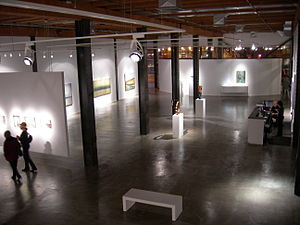
An art gallery is a room or a building in which visual art is displayed. In Western cultures from the mid-15th Century, a gallery was any long, narrow covered passage along a wall, first used in the sense of a place for art in the 1590s.[one] The Long gallery in Elizabethan and Jacobean houses served many purposes including the display of art. Historically, art is displayed every bit prove of condition and wealth, and for religious art every bit objects of ritual or the delineation of narratives. The get-go galleries were in the palaces of the aristocracy, or in churches. Every bit art collections grew, buildings became dedicated to art, condign the first fine art museums.
Among the mod reasons art may be displayed are aesthetic enjoyment, education, celebrated preservation, or for marketing purposes. The term is used to refer to establishments with distinct social and economical functions, both public and individual. Institutions that preserve a permanent collection may be chosen either "gallery of fine art" or "museum of art". If the latter, the rooms where fine art is displayed within the museum building are called galleries. Art galleries that practise non maintain a collection are either commercial enterprises for the sale of artworks, or similar spaces operated by fine art cooperatives or not-profit organizations. As part of the art world, art galleries play an important role in maintaining the network of connections between artists, collectors, and fine art experts that ascertain fine art.
Fine art museums versus galleries [edit]
The terms 'art museum' and 'art gallery' may be used interchangeably every bit reflected in the names of institutions around the globe, some of which are called galleries (e.g. the National Gallery and Neue Nationalgalerie), and some of which are called museums (e.chiliad. the Museum of Mod Art and National Museum of Western Art). However, establishments that brandish art for other purposes, but serve no museum functions, are but called fine art galleries.
The distinctive office of a museum is the preservation of artifacts with cultural, historical, and aesthetic value by maintaining a collection of valued objects. Fine art museums also office as galleries that display works from the museum'south own collection or on loan from the collections of other museums. Museums might be in public or private ownership and may be attainable to all or take restrictions on access. Although primarily concerned with visual fine art, art museums are oft used as a venue for other cultural exchanges and artistic activities, such as performance arts, music concerts, or poetry readings.
Galleries and the art world [edit]
The art earth comprises everyone involved in the production and distribution of fine art.[2] : xxiv The market for fine art depends upon maintaining its distinction as high culture, although during recent decades the boundary between high and popular civilization has been eroded by postmodernism.[three]
In the case of historical works, or Old Masters this stardom is maintained by the work's provenance; proof of its origin and history.[4]
For more recent work, status is based upon the reputation of the creative person. Reputation includes both aesthetic factors; art schools attended, membership in a stylistic or historical movement, the opinions of art historians and critics; and economic factors; inclusion in grouping and solo exhibitions and past success in the art market. Art dealers, through their galleries, have occupied a key part in the fine art world by bringing many of these factors together; such as "discovering" new artists, promoting their associations in group shows, and managing market valuation.[five]

Gallery Opening, July 2015
Commercial galleries [edit]
Exhibitions of art operating similar to electric current galleries for marketing art first appeared in the early modern period, approximately 1500 to 1800 CE. In the middle ages that preceded, painters and sculptors were members of guilds, seeking commissions to produce artworks for aristocratic patrons or churches. The establishment of academies of art in the 16th century represented efforts by painters and sculptors to heighten their status from mere artisans who worked with their easily to that of the classical arts such as poetry and music, which are purely intellectual pursuits. However, the public exhibition of art had to overcome the bias against commercial activity, which was deemed beneath the dignity of artists in many European societies.[six]
Commercial fine art galleries were well-established by the Victorian era, fabricated possible past the increasing number of people seeking to own objects of cultural and aesthetic value.[7] At the terminate of the 19th and the kickoff of the 20th century at that place were also the first indications of modern values regarding art; art as an investment versus pure aesthetics, and the increased attention to living artists as an opportunity for such investment.[eight]
Commercial galleries owned or operated by an art dealer or "gallerist"[nine] occupy the centre tier of the art market place, bookkeeping for most transactions, although non those with the highest budgetary values. Once limited to major urban art worlds such as New York, Paris and London, fine art galleries accept become global. Some other trend in globalization is that while maintaining their urban establishments, galleries also participate in fine art fairs such every bit Art Basel and Freize Art Fair.[3]
Art galleries are the primary connection betwixt artists and collectors. At the loftier end of the marketplace, a scattering of elite auction houses and dealers sell the piece of work of celebrity artists; at the low end artists sell their piece of work from their studio, or in breezy venues such as restaurants. Point-of-sale galleries connect artists with buyers by hosting exhibitions and openings. The artworks are on consignment, with the artist and the gallery splitting the proceeds from each sale. Depending upon the expertise of the gallery possessor and staff, and the item market, the artwork shown may be more than innovative or more traditional in way and media.[10]
Types of galleries [edit]
Galleries may deal in the master market place of new works past living artists, or the secondary markets for works from prior periods owned past collectors, estates, or museums. The periods represented include Former Masters, Modern (1900-1950), and contemporary (1950–present). Modern and contemporary may be combined in the category of Post-war art; while contemporary may be express to the 21st century or "emerging artists".[11]
Contemporary galleries [edit]
An enduring model for contemporary galleries was set by Leo Castelli. Rather than simply existence the banker for sales, Castelli became actively involved in the discovery and development of new artists, while expecting to remain an exclusive agent for their piece of work. Still he besides focused exclusively on new works, non participating in the resale of older work by the same artists.[12]
Secondary market [edit]
All art sales after the first are office of the secondary market, in which the artist and the original dealer are non involved. Many of these sales occur privately between collectors, or works are sold at auctions. Even so some galleries participate in the secondary market place depending upon the market conditions. As with any market, the major conditions are supply and need. Because art is a unique commodity, the artist has a monopoly on product, which ceases when the artist either dies or stops working.[13]
Outside the fine art world [edit]
Some businesses operate as vanity galleries, charging artists a fee to showroom their work. Defective a selection process to clinch the quality of the artworks, and having little incentive to promote sales, vanity galleries are avoided equally unprofessional.[xiv]
Non-profit galleries [edit]
Some non-profit organizations or local governments host art galleries for cultural enrichment and to support local artists. Non-turn a profit organizations may showtime equally showroom spaces for creative person collectives, and expand into full-fledged arts programs. Other non-profits include the arts equally part of other missions, such as providing services to low-income neighborhoods.[15]
- Artists Space was founded in 1972 in SoHo, New York Urban center.
- Westbeth Gallery is operated by the Westbeth Artists Residents Council
Arts districts [edit]
Historically, fine art globe activities have benefited from clustering together either in cities[3] or in remote areas offer natural dazzler.
The proximity of art galleries facilitated an informal tradition of art show openings on the same nighttime, which accept become officially coordinated as "showtime Friday events" in a number of locations.
Galleries selling the work of recognized artists may occupy space in established commercial areas of a city. New styles in art have historically been attracted to the depression rent of marginal neighborhoods. An artist colony existed in Greenwich Village as early as 1850, and the tenements congenital effectually Washington Square Park to house immigrants after the Ceremonious War also attracted young artists and avant garde fine art galleries.[xvi] The resulting gentrification prompted artists and galleries to motility to the neighborhood "south of Houston" (SoHo) which became gentrified in plough.[17]
Attempting to recreate this natural procedure, arts districts take been created intentionally past local governments in partnership with private developers as a strategy for revitalizing neighborhoods. Such developments often include spaces for artists to live and work as well every bit galleries.[18]
Temporary galleries [edit]
A contemporary practice has been the use of vacant commercial space for art exhibitions that run for periods from a single 24-hour interval to a month. Now called "popup galleries",[19] a precursor was Artomatic which had its offset consequence in 1999 and has occurred periodically to the present, mainly in the Washington metro area.
References [edit]
- ^ "Origin and Meaning of Gallery". Online Etymology Dictionary . Retrieved September 23, 2020.
- ^ Becker, Howard Saul (2008). Art Worlds (second. ed.). University of California Press. ISBN978-0-520-25636-1.
- ^ a b c Crane, Diana (2009). "Reflections on the Global Art Marketplace: Implications for the Sociology of Culture". Sociedade e Estado. 24 (2): 331–62. doi:10.1590/S0102-69922009000200002.
- ^ Oosterlinck, Kim; Radermecker, Anne-Sophie (2019). "'The Primary of …': Creating Names for Art History and the Art Market place". Journal of Cultural Economics. New York. 43 (i): 57–95. doi:10.1007/s10824-018-9329-1. S2CID 158075163.
- ^ Braden, 50.East.A.; Teekens, Thomas (2019). "Reputation, Status Networks, and the Art Market". Arts. 8 (3): 81. doi:10.3390/arts8030081.
- ^ Mainardi, Patricia (2018). "Show and Tell: Exhibition Practice in the Nineteenth Century". In Facos, Michelle (ed.). A Companion to Nineteenth-Century Art. Newark, United states of america: John Wiley & Sons, Incorporated. pp. 69–82.
- ^ Helmreich, Anne (2017). "The Art Marketplace and the Spaces of Sociability in Victorian London". Victorian Studies. 59 (3): 436–49. doi:x.2979/victorianstudies.59.iii.07. S2CID 149058582.
- ^ Scragg, Rebecca (2014). "The Rise of the Mod Art Marketplace in London, 1850–1939/The Development of the Art Market in England: Money as Muse, 1730–1900". Victorian Studies. 56 (two): 334–37. doi:ten.2979/victorianstudies.56.2.334. S2CID 144813124.
- ^ Kagan, Julia. "Gallerist". Investopedia . Retrieved September 24, 2020.
- ^ Moureau, Nathalie; Sagot-Duvauroux, Dominique (2012). "Four Business Models in Contemporary Fine art". International Journal of Arts Management. 14 (3): 44–56.
- ^ Winkleman, Edward; Hindle, Patton (2018). "Concern Models and Customary Practices". How to Start and Run a Commercial Art Gallery (2d ed.). Simon and Schuster.
- ^ "The Castelli Method". Retrieved September 26, 2020.
- ^ Anna Louie Sussman (January ii, 2018). "The "Expiry Upshot" on Artists' Prices Really Occurs When They're Alive". artsy.internet.
- ^ "Beware the Vanity Gallery - and why they should be avoided". Fine art Business Info . Retrieved September 25, 2020.
- ^ Henri Neuendorf (September 1, 2016). "Art Demystified: What Is the Role of Non-Profits in the Art World?". ArtNet.
- ^ "Greenwich Village and the Arts". Grey Art Gallery. 2016. Retrieved September 25, 2020.
- ^ Shkuda, Aaron (2013). "The Art Market, Arts Funding, and Sweat Disinterestedness: The Origins of Gentrified Retail". Journal of Urban History. 39 (4): 601–xix. doi:10.1177/0096144212443134. S2CID 143606427.
- ^ Goldberg-Miller, Shoshanah B. D.; Heimlich, Joe E. (2017). "Creatives' Expectations: The Office of Supercreatives in Cultural Commune Evolution". Cities. 62 (February): 120–thirty. doi:ten.1016/j.cities.2016.12.011.
- ^ "Everything You Need to Know about Popular-Up Galleries". Artsy . Retrieved September 3, 2021.
crosbyfeavainnince97.blogspot.com
Source: https://en.wikipedia.org/wiki/Art_gallery
0 Response to "What Is It Called to Attend an Art Gallery for a Featured Artist"
Enregistrer un commentaire