The Question of Reception Martial Arts Fiction in English Translation
Excerpted from "Shakespeare and Translation." The Edinburgh Companion to Shakespeare and the Arts, ed. Mark Thornton Burnett, Adrian Streete, and Ramona Wray. Edinburgh University Printing, 2011. pp. 68-87.
Full text bachelor at: gwu.academia.edu/joubin
Catherine: I cannot tell vat is dat.
Rex Harry: … I will tell thee in French … Je quand sur le possession de France, et quand vous avez le possession de moi,–permit me run into, what then? … It is as easy for me, Kate, to conquer the kingdom equally to speak so much more French. …
Catharine: Sauf votre honneur, le Francois que vous parlez, il
est meilleur que l'Anglois lequel je parle.King Harry: No, faith, is't not, Kate: but thy speaking of my
tongue, and I thine, most truly-falsely, must needs be granted to exist much at ane. But, Kate, dost thou understand thus much English language, canst k dear me?—Henry V five.2.169-183
Literary translation is a love affair. Depending on the context, it could be love at beginning sight or hot pursuits of a lover'southward elusive nodding approval. In other instances it could be unrequited beloved, and still others a test of devotion and faith. Or an eclectic combination of any of these events. Translation involves artistic creativity, not a workshop of equivalences. Equally homo civilisations adult and intersected, translation emerged every bit a necessary form of communication and a way of life. It highlighted and put to productive use the space between cultures, between individuals with different perspectives, and within one's psyche.
To call up of translation as a honey affair does not eliminate the hierarchies that are part of the historical reality. In terms of its symbolic and cultural capital, literary translations always reverberate the global order of the centre and the peripheral. Shakespeare remains the most canonical of canonical authors in a language that is now the global lingua franca. Translating Shakespeare into Zulu produces very different cultural prestige than translating Korean playwright Yi Kangbaek into English. Does translating Shakespeare empower those for whom English is a second linguistic communication, or reinforce cultural hegemony? There is no uncomplicated answer. When his translation of Village was published, King D. Luis was praised in 1877 for bringing honour to his country by "giving to the Portuguese Nation their showtime translation of Shakespeare" (Pestana, 1930, 248-263). In contrast, the Merchant-Ivory'due south metatheatrical film Shakespeare Wallah interrogates this sense of entitlement and prestige. Following the stride of the English managing director Geoffrey Kendal'due south travelling company in Bharat, nosotros come across the land'south ambiguous attitude towards Shakespeare and England. Translations, as they age, also serve as useful historical documents of past exigencies and cultural conditions (Hoenselaars, 2009, 278-279). In what follows, we shall consider literary translations in their own right and in relation to i some other and other texts.
Shakespeare in Borrowed Robes
One of the most thought-provoking cases of literary translation is Shakespeare, the nigh widely translated secular author in the by centuries, with several editions in many languages (e.g., the Complete Works has been translated into German a number of times beginning with the German Romantics, and into Brazilian Portuguese by Carlos Alberto Nunes in 1955-67 and past Carloes de Almeida Cunha Medeiros and Oscar Mendes in 1969). Literary translation sometimes modernises the source text (Eco, 2001, 22), which brings the text forcefully into the cultural register of a different era. As such, Shakespeare in translation acquired the capacity to appear every bit the gimmicky (and platonic companion) of the German Romantics, a spokesperson for the proletarian heroes, required reading for the Communists, and even a transhistorical icon of modernity in East asia. Even new titles given to Shakespeare's plays are suggestive of the preoccupation of the society that produced them, such as the 1710 German language adaptation of Hamlet title Der besträfte Brudermord (The Condemned Fratricide) and Sulayman Al-Bassam's The Al-Hamlet Summit (English language version in 2002; Standard arabic version in 2004). While Western directors, translators, and critics of The Merchant of Venice tend to focus on the ethics of conversion and religious tensions with Shylock at center stage, the play has a completely unlike face in East asia with Portia as its central character and the women'southward emancipation motion in the nascent capitalist societies as its main business, as evidenced by its common Chinese title A Pound of Mankind, a 1885 Japanese adaptation of The Merchant of Venice titled The Season of Cerise Blossoms, the World of Money, and a 1927 Chinese silent film The Woman Lawyer.
Shakespeare's oeuvre is nowadays on every populated continent, with sign-language renditions and recitations in Klingon in the Star Trek to boot. Hamlet is ane of the most frequently translated and staged plays in the Arab globe (Mohamed Sobhi'southward 1977 version in Egypt, Khaled Al-Tarifi'southward version in Hashemite kingdom of jordan, and more). Since its first staging in Copenhagen in the early nineteenth century, Hamlet has both visceral and historical connections with Denmark (Hansen, 2008, 153)—thank you in function to the famed "Village castle" Kronborg. King Lear has a special place in Asian theatre history and Asian interpretations of filial piety. Romeo and Juliet enjoys a global renaissance in genres ranging from punk parody to Japanese manga. The Sonnets and The Merchant of Venice have been translated into te reo Maori of New Zealand and hailed every bit a major cultural event. By 1934, Shakespeare had been translated into over 200 Indian languages using Indian names and settings. Shakespeare has come to be known as unser Shakespeare for the Germans, Sulapani in Telegu, and Shashibiya in Chinese.
This is not to say that translating Shakespeare is ever a rosy undertaking, or that Shakespeare has a universal appeal. Wars, censorship, and political ideologies can suppress or encourage the translation of particular plays or genres for one reason or another, or outlaw Shakespeare altogether (as is the example during the Chinese Cultural Revolution, 1966-1976). The 1930s is a fourth dimension when the political expediency drove readers, performers, and audiences to a select gear up of Shakespearean plays in the Soviet Union, Nippon, and Communist china. The regicide and assassinations in Hamlet raised the eyebrows of the Japanese censors in the decade when Nippon was preparing to challenge European and American supremacy. Hamlet was banned, along with one-half a dozen other left-wing plays, at the International Theatre Day organized past the Japan League of Proletarian Theatres (led by Murayama Tomoyoshi) on February 13, 1932, on the basis that the play may motivate rebellions confronting the rightist government. Ironically, Stalin expressed distaste for night, tragic plays such every bit Village, having famously declared that life has become more joyful for the communist state in 1935. Shakespeare's comedies fit the propagandistic goal and therefore had a firm place in the state-endorsed repertoire for the phase and reading materials in the USSR and its close ally, China, of the fourth dimension. Shakespeare became, in the Soviet and Chinese ideological interpretations, the spokesperson for the proletariat, an optimist, and a fighter against feudalism, through the "bright" comedies such equally Much Ado Well-nigh Nothing.
Genres and Translation
Genres have a part to play in translation as well. The tragedies and some comedies are more frequently translated, staged, and filmed around the world, considering of their capacity to be more easily detached from their native cultural settings and the self-reinforcing bicycle of familiarity. In India, for example, Hamlet and the Merchant of Venice take been translated more than fifty times and The One-act of Errors has over thirty versions in different languages in Bharat, only the only history plays to have been translated into Hindi are Henry 5 and Richard II, and only ane version each. While Shakespeare's global reputation may seem to be driven by translations of his tragedies, comedies, and the sonnets because of the sheer number of performances and translations since the seventeenth century, the history plays take their own histories of global reception beginning with a 1591 Polish functioning of Philip Waimer's stage version of Edward III in Gdansk. Laurence Olivier's wartime film version of Henry Five in 1944 is far from the but or the earliest translations—interlingual, intralingual, or intersemiotic—of the history plays, though each instance of translation focuses on different articulations of national histories.
British performances, understandably, are more oftentimes geared toward amalgam a coherent national identity in relation to Britain'southward friends and foes on the European continent (Hoenselaars, 2004, 9-34). Non-anglophone translations of history plays, on the other hand, often use the plays to interrogate the notion of national history. One of the better-known examples in the West is Richard III: An Arab Tragedy by Sulayman Al-Bassam of Kuwait, a production that has toured widely around the world. Plays such as Henry Five that polarizes the English and the French accept a contentious reception in France and Europe, serving as a forum for artistic experiment and political debates. Nevertheless farther ashore, plays from both the outset and 2nd tetralogies, excluding King John, found new homes in nationalist projects of modernization and school performances in Japan, Taiwan, China, and elsewhere. While the Asian translators and adaptors' involvement did not e'er lie in medieval English history (or Shakespeare'south imagination thereof), such as the feud betwixt the Houses of York and Lancaster, they drew parallels to inspire analogous reflections on local histories. Kinoshita Junji's translations of Henry VI and Richard 3 echoes The Tale of the Heike, a thirteenth-century Japanese literary masterpiece chronicling the clashes betwixt the Heike and the Genji clans. Henry Iv appeared in prose as a serialised story in The Short Story Magazine in early twentieth-century Shanghai. It was soon published every bit a volume and prominently advertised. Its appeal was due in no small-scale office to the Chinese discourse of modernity and unified national identity in a time of national crisis as the country was threatened by Japanese and European colonial powers. The Chinese intellectuals of the fourth dimension looked outward for other nations' experiences. More recently, Henry Four Parts 1 and 2 were adjusted into a play for the Taiwanese glove boob theatre in 2002, a hybrid genre blending elements of Chinese opera, marionette theatre, and street theatre.
Past the 20-first century, all of Shakespeare'due south plays, followed past the Sonnets, take had long histories of translation. 2009 witnessed the publication of a 748-page critical anthology with a title that parallels and talks back to the 69-page quarto of 1609: William Shakespeare'southward Sonnets for the First Fourth dimension Globally Reprinted: A Quartercentenary Album with a DVD, containing samples of the sonnets translated, performed, or parodied in more than 70 languages and dialects. Since Shakespeare'southward sonnets in translation have been discussed extensively in the anthology, this chapter will focus on the plays. The spread of Shakespeare'south work has accelerated due to the rapid localisation of globally circulating ideas and with the globalisation of local forms of expression, fuelled starting time by trade and slavery, and at present by the digital and Internet culture. A new age of Shakespeare in translation is upon us.
Translators and Adapters
Many of the translators of Shakespeare's plays and sonnets are major figures in the world of letters in and across their own cultures: August Wilhelm von Schlegel and Paul Celan in Germany, Boris Pasternak in Russia, Tsubouchi Shōyō in Japan, Liang Shiqiu in Taiwan, Julius Grand. Nyere in Tanzania, Aimé Césaire in Martinique, Rabindranath Tagore in India, Voltaire in France, Elyas Abu Shabakeh in Syria, Wole Soyinka in Nigeria, Charles and Mary Lamb in England, and countless others. Some cultures have canonical, received versions for readers and actors, such as Zhu Shenghao'due south Chinese translation of The Consummate Works, but the audience in other cultures, notably France, cannot claim to have any set of standard translations (Morse 2006, 79). There are numerous stage and film directors, painters, composers, choreographers, and artists, who appoint and transform Shakespeare, as discussed in other chapters in this volume. The proliferation of Shakespeare in translation, specially in non-European languages, makes nonsense the notion of a homogenized, authenticated Shakespeare in British English.
Translation is far from a one-way street from the English language text to a strange one. Rewritings of Shakespeare sometimes refer to and borrow from 1 another, resembling the process of cantankerous-pollination. Examples include Chee Kong Cheah'southward Craven Rice State of war, a Singapore flick that parodies Baz Luhrmann'southward William Shakespeare's Romeo + Juliet, and Wu Hsing-kuo'south reading of Macbeth in his The Kingdom of Desire, a Beijing opera play, that alludes to Akira Kurosawa'south film Throne of Blood. These borrowings have enriched our understanding of Shakespeare and world cultures. It is noteworthy that Shakespeare was not always translated directly from English into strange languages. Because of historical or political reasons, double or triple filtering was not uncommon. When composing the choral symphony Roméo et Juliette, Hector Berlioz worked from Pierre Le Tourneur's French translation of David Garrick's English adaptation of Shakespeare'due south play. French neoclassical versions were the foundation for early Russian translations of Shakespeare, while the first Shakespearean performance in colonial Korea was a Japanese version of Hamlet in 1909. Teodoro de la Calle's 1802 Spanish translation of Othello was based on Ducis'due south French version. As a result, Shakespeare in translation has been used as the proving ground of translation theory, and information technology is the core of the Shakespeare industry.
Translation as a Theme in Shakespeare'southward Plays
What state, friends, is this?
Twelfth Night i.ii.1
However, estrangement and transnational cultural flows are not exclusively a mod affair. Cultural commutation was an unalienable part of the cultural life in Renaissance England. Translation, or translatio, signifying "the figure of transport" (Parker 1987, 36-45), was a common rhetorical trope that referred to the conveyance of ideas from one geo-cultural location to some other, from one historical period to another, and from one creative form to some other. London witnessed a steady stream of merchants and foreign emissaries from Europe, the Barbary declension, and the Mediterranean, and thousands of Dutch and Flemish Protestants fled to Kent in the late 1560s due to the Spanish persecution. In 1573, Queen Elizabeth I granted Canterbury to have French taught in school to "those who desire to learn the French tongue" (Cross, 1898, 15). The drama of the time reflected this involvement in other cultures. But one of Christopher Marlowe's plays, Edward II, is ready in England, and he translated Book one of Lucan'south Civil Wars, an ballsy canvassing the geographical imaginaries from Europe to Egypt and Africa. Thomas Heywood's The Fair Maid of the West explores the role of woman and cantankerous-cultural issues. Nearly of Shakespeare's plays are set up outside England, in the Mediterranean, France, Vienna, Venice, and elsewhere. Even the history plays that focus intently on the question of English language identity and lineage characteristic foreign characters who play key roles, such as Katherine of Aragon in Henry 8, and the diplomatic relations betwixt England and France. Thomas Kyd flirted with the idea of multilingual theatre in The Spanish Tragedy through a short play-within-a-play scene, "Soliman and Perseda," in "sundry languages" (four.4.74). Pidgin English language is masqueraded as fake Dutch in Thomas Middleton's No Wit, No Help Like a Woman's. Other examples abound.
Inside Shakespeare's plays, the figure of translation looms large. Translational moments create comic relief and heighten the awareness that communication is not a given. Translation also served as a metaphor for physical transformation or transportation. Claudius speaks of Hamlet's "transformation" (two.2.5) and asks Gertrude to "interpret" Village's behaviours in the previous scene (the cupboard scene) and then that Claudius can "empathise … the profound heaves" (iv.1.2). Gertrude non only relays what Hamlet has but done only too provides her interpretations, every bit a translator would, of her son's deeds. More so than Hamlet, Henry V contains several instances of literal translation, including the well-known wooing scene quoted above. Translation serves every bit a figure of transport, theft, transfer of belongings, and change across linguistic and national boundaries, as the characters and audience are ferried back and forth across the Channel. The peace negotiations dictate that the English monarch marries the girl of Charles Six of France, uniting the two kingdoms. The "broken English" (5.two.228) in the light-hearted scene symbolises Henry Five's authority over Catherine and French republic after the English language victory at the Battle of Agincourt. Still, the Epilogue reminds usa that the union is far from a closure (Epilogue 12), for information technology produces a son who is "half-French, half-English" (5.2.208). The English conqueror pretends to be a wooer to Catherine of France who cannot reject him freely. One is unsure whether Catherine is speaking the truth that she does not sympathise English well plenty ("I cannot tell") or just being coy—playing Harry's game, though Catherine eventually yields to Henry V'due south request: "Dat is as information technology shall please de roi mon père" (5.2.229). Too, The Merry Wives of Windsor is saturated by translational scenes. Mistress Apace receives a language lesson in Latin (iv.ane), and the French Doctor Caius makes "fritters of English (5.v.143). Shakespeare takes great please in wordplay, and many comic puns rely on orthographic contrasts and resemblances of pronunciations of words in different languages and dialects. Love's Labour'south Lost, a polyglot "feast of languages" (v.1.37), features a critique of Armado's Spanish-inflected orthography past Holofernes (5.i.sixteen-25).
The idea of translation is given a spin in A Midsummer Night's Dream where the verb to translate is expansive and elastic, signifying transformations most wondrous and strange. Upon seeing Bottom turned into an donkey-headed figure, Peter Quince cries in horror: "Anoint thee, Lesser, bless thee. One thousand fine art translated!" (iii.i.105). Other characters use the verb in similar ways to refer to a broad range of transformations. Helena desires to be "translated" into Hermia (ane.i.191), and a honey potion transforms characters that come up across its path. Indeed stage performances subject actors to various forms of "translation." In the case of the start operation of A Midsummer Nighttime's Dream in London, the stage transforms a Chamberlain's Men actor to the grapheme of an Athenian weaver named Nick Bottom to the role of a tragic lover, Pyramus, in a play-within-a-play, and to an ass-headed monster—an object of obsession in Titania's fairy kingdom.
Linguistic communication barriers emerge equally a moment of self-reflection for Portia in The Merchant of Venice even as she uses it to typecast some of her suitors from all over the globe. In the first exchange betwixt Narissa and Portia, when asked of her opinion of "Falconbridge, the immature baron of England," Portia goes right to the heart of the problem. Since Falconbridge "hath neither Latin, French, nor Italian," it is impossible to "converse with a impaired testify." Portia is enlightened of her own limitations, too. She admits "I have a poor pennyworth in the English," which is why she can say cipher to him, "for he understands not [her], nor [she] him." Falconbridge's odd expression of cosmopolitanism does not fare any better, every bit Portia observes snidely: "I remember he bought his doublet in Italy, his round hose in France, his bonnet in Frg, and his behaviour everywhere" (1.2.55-64).
Every bit products of an age of exploration, Shakespeare'due south plays demonstrate influences from a rich treasure trove of multilingual sources in Latin, Italian, Spanish, and French. Arthur Golding's 1567 English translation of Ovid'due south Metamorphoses, a Roman collection of mythological tales, provided a rich network of allusions for Shakespeare's comedies (e.g., the story of Diana and Actaeon). In Titus Andronicus, the mutilated Lavinia is able to interpret and communicate her thoughts via Ovid even though she is unable to speak or write. While other sources provided stories for Shakespeare to embellish, the Metamorphoses was an important stockpile of allusions for Shakespeare. Thomas Northward'south 1579 version of Plutarch'south Lives of the Noble Grecians and Romans is a major source for Shakespeare'due south Antony and Cleopatra and other Roman plays. Shakespeare rendered North's prose in verse and made numerous changes. Shakespeare knew Latin and French, and was up to engagement on the translated literature during his times. He probably read Giraldi Cinthio's Hecatommithi in Italian earlier penning Othello, and regularly looked beyond English-linguistic communication sources for inspiration for stories to dramatize. It is by no accident that Shakespeare put Julius Caesar's famous last words in Latin, equally "Et tu, Animal?" (3.1.77) rather than Greek in Plutarch, the play's source. Perhaps, as Casca complains in some other scene, "it was Greek to me" (1.2.278). Shakespeare was a bang-up translator in the sense of transforming multiple sources, and he was a talented synthesiser of different threads of narratives.
The of import role of translated literature is indisputable in the evolution of Shakespeare'due south art. Shakespeare became a global author—both in terms of his reading and the impact of his work—long before globalisation was fashionable. In 1586 a grouping of English language actors performed before the Elector of Saxony, marking the beginning of several centuries of intercultural performances of Shakespeare. Romeo and Juliet was staged in Nördlingen in 1604, and Hamlet and Richard II were performed on board an English East India Company ship anchored nearly Sierra Leone in 1607). Four hundred years on, Shakespeare has come total circle. Given Shakespeare's talents and interest in translational literature, it is fitting that his works have found new homes in such a wide range of languages and genres.
T.S. Eliot's quip in The Four Quartets aptly captures the journeying that is translation. The end of the intercultural journeying will have united states of america to where we started and enable u.s.a. to know the place for the first time. Both translation as a dramatic motif and drama in translation provide useful contexts for sustained reflections on the "fictions of national coherence" in Shakespeare's times (Levin and Watkins, 2009, 14) and traits that differentiate and unite different cultures in our times. While we will not exist able to delve into these early modern cases inside the constraints of the book, information technology is useful to bear in heed that in that location is a long and broad history of Shakespeare in translation and transformation.
3 Modes of Translating Shakespeare
The lack of overt moralisation in Shakespearean dramas, along with other features such as their "vernacular applicability" on screen (Burnett, 2005, 185) and flexibility to accommodate contrasting perspectives through dramatic dialogues, have contributed to their wide appeal around the world—in intralingual rewriting (Charles and Mary Lamb's nineteenth-century prose narrative, Tales from Shakespeare), interlingual adaptation (Bengali translation of Macbeth), and intersemiotic transformations, to use Roman Jakobson's theory. The last category encompasses a wide range of transformations of Shakespeare'southward work from page to phase, screen, and other media. Adrian Noble'south English production of A Midsummer Dark's Dream "translated" the English language text on the page to the linguistic communication of the phase, while Verdi transformed Othello into Otelo, an Italian opera. John Everett Millais' painting, "Ophelia" (Tate Britain, London), depicts the tragic death of Ophelia is so memorable that information technology has become iconic, supplementing, if not replacing, the passages about Ophelia'due south demise in Hamlet in popular imaginations. Shakespearean dramas were in fact important sources for many Victorian painters.
Each of these modes offers unique challenges and rich rewards. According to Jakobson, intralingual translation, or rewording, is "an interpretation of verbal signs by means of other signs of the same language" which is akin to process of meaning making. 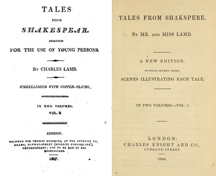 "An assortment of linguistic signs is needed to introduce an unfamiliar word," reasoned Jakobson (139). But intralingual translation does not produce consummate equivalences. Rewriting Shakespeare's plays in nineteenth English prose narratives involves making choices well-nigh the characters' motives, "morals" of the play, and even selecting a set of coherent meanings from a wide range of meanings afforded by puns and wordplay. One of the nearly widely-read and globally influential intralingual translations is Tales from Shakespeare by Victorian author and critic Charles Lamb and his sister Mary. The 1807 text was designed "for young ladies" considering, equally the Lambs reasoned, "boys being generally permitted the apply of their fathers' libraries … before their sisters are permitted to look into this manly book" (1963, six). The moralistic, simplified, prose rendition of select Shakespearean tragedies (by Charles) and comedies (past Mary) was initially intended for women and children who would non otherwise have admission to Shakespeare's plays, but it has remained i of the most popular English-language rewritings to this twenty-four hour period (fig. 1). Charles Lamb was a respected essayist and critic in his times, considered past such figures as William Hazlitt to be a sounder authority on poesy than Johnson or Schlegel. The Tales from Shakespeare bears the mark of its times, but the drove of twenty stories was an enduring monument to Shakespeare in translation and Victorian literature. Though the Lambs openly best-selling that their rewriting was gendered and classed, they retained as much phrases and passages from Shakespeare every bit possible. We observe a Hamlet who is caring and grieving for clearer reasons:
The young prince . . . loved and venerated the memory of his dead father near to idolatry, and being of a nice sense of honour, and a well-nigh exquisite practiser of propriety himself, did sorely take to heart this unworthy conduct of his female parent Gertrude: insomuch that, between grief for his begetter's death and shame for his mother's marriage, this immature prince was overclouded with a deep melancholy, and lost all his mirth and all his skillful looks (290).
Like Henrietta Maria Bowdler'south The Family Shakespeare (1807), Tales tapped into the emerging market of books for middle-course children past censoring the "obscenity" in plays such every bit Othello and removing anything that may be offensive to the Victorian sensibilities.
Betwixt 1999 and 2007, several new editions of the Tales were brought out in English language, Chinese, and other languages. Mary Lamb wrote virtually of the prose stories (Charles wrote only half-dozen). It has inspired similar ventures in England and abroad. Sir Arthur Thomas Quiller-Burrow published a sequel of sort before the nineteenth century winded down: Historical Tales from Shakespeare (1899). It supplemented the Lambs' text by covering Coriolanus, Julius Caesar, King John, Richard Ii, Henry IV, Henry V, Henry 6 and Richard III, most of which the Lambs omitted. The Lambs' Tales has exerted a great influence in the early reception of Shakespeare in other countries, especially Eastern asia. The text was reframed in Prc for the male person elite class that operated co-ordinate to moralizing principles. In 1904, Wei Yi translated information technology orally, and his collaborator Lin Shu, a prolific translator who could not read English language, rendered it into classical Chinese with embellishment. Between 1877 and 1928, the Tales were translated and printed 97 times in Japan, while over a dozen editions appeared in Communist china between 1903 and 1915. Early Japanese productions were based on the Lambs' Tales rather than complete translations of the plays themselves. The 1868 kabuki production of Julius Caesar and Inoue Tsutomu'due south retelling of The Merchant of Venice in 1883, titled "The Accommodate for a Pound of Homo Mankind," are 2 such examples (Quinn, 2011, np).
Translating Shakespeare into a foreign language is a different thing. It involves new semantic, semiotic, and cultural contexts. Jakobson believes that "all cognitive feel and its classification is conveyable in any existing language" (140), but when a grammatical category is absent in the target linguistic communication, its meaning may be translated "by lexical means" (141). While European translators can draw on the shared Judeo-Christian and Greco-Roman traditions, the further a linguistic communication is situated from the English culture the more than creative strategies of displacement a translator will have to deploy. Translating Hamlet'south "to be or non to be" speech into Japanese, for example, will require substantial rewriting, considering Japanese does not have the verb to be without semantic contexts. Jakobson gives a similar example of translating an Italian rhyming epigram ("Traduttore, traditore") into English language ("the translator is a betrayer"). For the English language judgement to make sense, the adage will have to be elaborated to specify what message the translator conveys and what values he betrays, simply the paronomastic value of the epigram volition exist lost (143). Working with Japanese, a language more complex than English from a sociolinguistic point of view, a translator would have to wrestle with more twenty first- and second-person pronouns to maintain the ambivalence and subtlety of gender identities in a play such as Twelfth Nighttime. In improver to making the right option of employing the familiar or polite style based on the relation between the speaker and the addressee, the male and female person speakers of Japanese are each confined to gender-specific personal pronouns at their disposal. Before a translation tin be undertaken, decisions will take to be made on the register and gendered expressions to convey Orsino'southward comments nearly love from a male perspective and Viola's apology for a adult female's love when in disguise as Cesario in Twelfth Night, or the exchange between Rosalind in disguise every bit Ganymede and Oliver on her "defective a man's heart" when she swoons, nearly giving herself away (4.iii.164-176). But limitations create new opportunities and bring translation closer to an act of performative estimation.
Differences in grammatical construction bated, earthy language and puns too pose a challenge. The substitution betwixt Samson and Gregory in Romeo and Juliet presents an opportunity for innovation and self-censorship:
Samson: I will show myself a tyrant: when I have fought with the men I will be civil with the maids—I will cutting off their heads.
Gregory: The heads of the maids?
Samson: Ay, the heads of the maids, or their maidenheads, take it in what sense thou wilt.
Gregory: They must have it in sense that feel it.
Samson: Me they shall feel while I am able to stand, and 'tis known I am a pretty piece of flesh (one.1.18-26).
Christoph Martin Wieland's 1766 German version excised this scene in its entirety and begins with the encounter betwixt Gregory, Samson, Abraham, and Benvolio and the ensuing fight (ane.1.29-). Along like lines, Goethe'due south 1812 adaptation of the play (based on Schlegel's poetry translation) presents a sanitized version, turning Romeo from a volatile youth to a more responsible man. References to the lovers' bodies are replaced by purified language. Juliet'south comment to her nurse that she will die "maiden-widowèd" because "decease, not Romeo, take [her] maidenhead" (3.2.135-137) is rid of the reference to virginity. Goethe'due south Juliet says that death, not Romeo, follows her to her bridal bed. Cao Yu (1910-1996), an achieved modern Chinese playwright, felt every bit uncomfortable about the passage but approached the issue differently. Diverting the attention from maidenhead to the action of cutting off the caput, Cao used the verb gàn to activate the latent connection between cutting off the maids' heads and Samson's subsequently annotate about his sexual prowess. Gàn has a very broad range of meanings from innocent daily usage to profanity, including to do, to get rid of, and to copulate. Schlegel translated the passage, simply used "Jungfrau" (virgin) and "Jungfräulichkeit" (virginity) to translate the wordplay. In addition to translating the "pretty piece of flesh," Schlegel has Samson say suggestively that the young women volition feel the bespeak of his sword ("die Spitze meines Degens") until it becomes edgeless ("stumpf"), which is not found in Shakespeare's text. Other twentieth-century Chinese translators have come up with various ways to interpret this passage, but they share a mutual trouble with the wordplay, because "head" and "maidenhead" in Chinese do not have orthographic and phonetic connections. Zhu Shenghao used nipple to translate this, every bit the second character of naitou (nipple) is the same as tou (head). In Fang Chong'due south revision to Zhu'southward translation, the reference to head is excised. Samson threatens to take the women's lives and elaborated that he might as well take their virginity which they cherish as much as their lives.
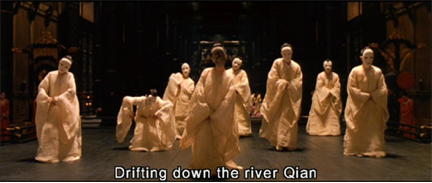
Translating Shakespeare from page to stage or some other medium in a different culture involves some of the same challenges outlined higher up, but information technology juxtaposes the ability of Shakespeare'due south words with that of nonverbal expressions and kinetic free energy. Intersemiotic translation, or transmutation in Jakobson'southward terms, involves the interpretation of "verbal signs by means of signs of nonverbal sign systems" (139). Information technology is hardly surprising that information technology is the intersemiotic transmutations that accept buoyed the global Shakespeare industry. Critics are optimistic nigh Shakespeare without his linguistic communication and fifty-fifty across his genres: "Not needing to record in English on the soundtrack, [filmmakers such as Akira Kurosawa] enjoyed the luxury of reinventing the plays in purely cinematic terms" (Rothwell, 2004, 160). A recent case is a Chinese martial arts film adaptation of Village by Feng Xiaogang (2006), entitled The Banquet and released in North America as the Fable of the Blackness Scorpion. The film stars Zhang Ziyi, Ge You, Zhou Xun, and Daniel Wu. Set in tenth-century People's republic of china, the film reimagines the Hamlet narrative through stylised presentation and offers a fresh perspective on traditionally silenced characters such as Ophelia. The English critical and dramaturgical traditions treat Ophelia every bit a character whose significance lies more often than not in information she conveys to the audience on Hamlet. The same is true of Anglophone cinematic representations of Gertrude. Many Western films and productions make Ophelia either kittenish or irritated, but Feng'southward film combines both the qualities of innocence and a passionate lover in its representation of Ophelia. The Banquet gives Qing Nü (fig. 2), the Ophelia effigy and a symbol of purity,  palpable and vocal presence in a court inhabited past scheming courtiers, ministers, empress, and usurper. Having gone mad for honey of Prince Wu Luan, the Hamlet effigy, Qing Nü enters uninvited in the concluding scene, the coronation of Empress Wan, the Gertrude effigy. Seemingly oblivious to her intrusion to one of the most important courtroom ceremonies, she announces that she and a troupe of dancers will perform a dear song to honor the late prince who is assumed to exist dead. A daring and bold motility. The audition is left to ponder whether this deed reflects her innocence or calculation, for, in several scenes, Qing Nü has shown her headstrong will to express her dearest for the prince even at the cost of offending the empress. Qing Nü and her entourage don white, neutral masks reminiscent of those used in noh performances. The vocal she sings virtually a boat girl is pregnant in its reference to Qing Nü'south extra-sensorial communication with the prince: "Trees live on mountains, and branches live on copse / My centre lives for your heart, but you practice not see me" (Feng, 2006). Coupled with the masked trip the light fantastic toe performed by a sane Ophelia figure, Qing Nü'southward lyrics echo only too add new meanings to Ophelia's songs in Hamlet, sung when she is mad: "How should I our truthful love know / From another 1?" (iv.v.23-24). The Banquet is an exercise in considering the events from the perspective of Ophelia who takes affair into her own hands (fig. 3 and 4).

The stage besides provides infinite possibilities for intersemiotic translation. Problems of translation and cross-cultural communication have been featured in three contemporary Asian productions that are themselves translations and adaptations of Shakespeare'due south plays. To facilitate discussion, we will now turn to three adaptations of Male monarch Lear that present the play in monolingual, bilingual, and multilingual formats. These works share the aforementioned conviction to link Lear to contemporary Asian cultures and political history. At the same time, they are set apart from one some other by their distinctive approaches to the problem of self-identity in Lear and in contemporary culture. Lear is chosen as our instance study because it occupies a special place in the history of Asian theatre since some scenes were first performed in English in Chowringhee Theatre, Calcutta, in 1832, and because the 3 adaptations provide usefully contrasting perspectives on intersemiotic translation. Videos of these three productions are too freely accessible on the Asian portal of the Global Shakespeares digital archive (http://web.mit.edu/shakespeare/asia/). Filial piety, patriarchal say-so, and self-knowledge are amid the themes that resonate with Asian directors and audiences' concerns.
Taiwan-based managing director and actor Wu Hsing-kuo'due south solo Beijing opera adaptation in Mandarin Chinese, titled Lear Is Here (2001), is a postmodern pastiche of ten characters including Wu himself as a character. The Buddhist interpretation of Lear also informed Wu'southward autobiographical narratives. As a Beijing opera actor in Taiwan where recent nativist campaigns have generated an essentialist discourse about bona fide Taiwan identity, Wu establish himself at the mercy of the isle authorities and residents' anti-Chinese sentiments. Adding insult to injury, Wu has been seen every bit a rebellion to the Beijing opera tradition considering of his interest in intercultural theatre and Western drama. With his married woman Lin Hsiu-wei, dancer and choreographer, he founded the Contemporary Fable Theatre in Taipei in 1986. Amid the company's best known Beijing opera plays are The Kingdom of Desire (Macbeth), The Revenge of the Prince (Hamlet), The Tempest, Oresteia, and Medea. The tension between father and kid in Lear provided a framework for Wu to explore his uneasy relationship with his Beijing opera primary and with the establishment in full general. In more ways than one, the play has get a ritual that redeems Wu through public performance of a private experience. Wu'due south accommodation opens with the scene of the mad Lear in the storm (3.2), a solo bout-de-force during which he combines mod dance steps, Beijing opera gestures, strides, minced steps, somersaults, and hitting movement of his long Beijing opera beard and sleeves to "translate" Lear's interrogation of the heaven.


Toward the end of this scene, he asks "Who am I?" kickoff equally Lear and then as himself, an player (fig. five and 6). The question is key in Lear, and the first human action of Lear Is Hither retains a line-past-line translation of the post-obit passage:
Lear: Doth any hither know me? This is not Lear.
Doth Lear walk thus? Speak thus? Where are his optics?
Either his notion weakens, his discernings
Are lethargied—Ha! Waking? 'tis not and then.
Who is information technology that an tell me who I am? (1.4.226-thirty)
Wu brings his life feel to touch Lear, and eventually transforms himself out of the character on stage, a radical move in Beijing opera functioning. He takes off his headdress and armour costume in full view of the audience, and uses the now eyeless headdress and beard as a fictional interlocutor. Equally well, Wu's resistance to the rigid system of performance passed down by his main takes other forms such equally cross-dressing. Trained in the male combatant role type, Wu specializes in characters that are generals, patriarchs, or ministers. Beijing opera actors practise not usually cantankerous over to other function types. In the solo operation, Wu non only plays the wronged father, but besides the unruly daughters, a wronged son (Edgar), and the blinded Gloucester. Lear Is Here taps into a rich reservoir of nonverbal signs, via Beijing opera and experimental theatre, to translate some of the most powerful emotions in Shakespeare'south play.
The theme of generational gap in King Lear also lends itself to experiments with languages. Chinese-British manager David Tse staged a Standard mandarin-English bilingual version of King Lear in 2006 with his London based Yellow Earth Theatre in collaboration with Shanghai Dramatic Arts Centre. The Buddhist notion of redemption and reincarnation informs some of the pattern elements and presentational styles. The product opens and closes with video footage, projected onto the iii interlaced flooring-to-ceiling reflective panels, that hints at both the beginning of a new life and life every bit endless suffering. Images of the faces of suffering men and women deliquesce to show a crying newborn being held upside down and smacked. The production toured Prc and the Britain and was staged during the Royal Shakespeare Company's Complete Works Festival. Set up in 2020 against the backdrop of cosmopolitan Shanghai, this futuristic adaptation reframed the epistemological gap betwixt Lear and Cordelia in terms of linguistic divergence. The play is close to Tse'southward centre, as he believes that Lear speaks strongly to diaspora artists and audiences who maintain links, but are unable to fully communicate, with their families residing in their home countries. As the poster (fig. vii) makes abundantly clear, the production focuses on the questions of heritage and filial piety. The tag line, in Mandarin and English language, reads "Which of you shall we say doth love us virtually?" Each of the characters has a primary language: English or Mandarin. On rare occasions, the characters may switch between two languages. Bilingual supertitles are provided. Lear's famous examination of dear in the division-of-the-kingdom scene is framed inside the context of Confucianism. The Confucian family values implicate family unit roles into the social hierarchy, and the Shanghai Lear insists on respect from his children at home and in business settings. Lear, a business tycoon, solicits confessions of beloved from 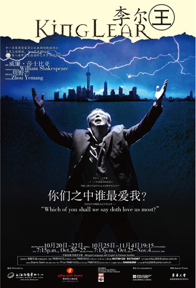 his 3 daughters. Residing in Shanghai, Regan and Goneril are fluent in Chinese and are ever so articulate as they convince their father of their unconditional honey of him. Cordelia, on the other hand, is both honest and linguistically challenged. She is unwilling to follow her sisters' example, but she is unable to communicate in Chinese with her father, either. Her silence, therefore, takes on new meanings. A member of the Chinese diaspora in London, Cordelia participates in this important family and business meeting via video link. Ironically but mayhap fittingly, the only Chinese word at her disposal is meiyou ("naught"). In the tense exchange between Cordelia and Lear, the give-and-take nothing looms big as Chinese fonts are projected onto the screen panels backside which Cordelia stands. Uninterested in the ontological or lexical significance of aught, Lear urged Cordelia to requite him something. The production capitalises on the presence of two cultures and the gap between them, and the bilingualism on phase is supplemented by bilingual supertitles. Whether in the Uk or China, the majority of its audiences could only follow ane role of the dialogue at ease and had to switch between the action on stage and the supertitles. The play thus embodies the realities of globalisation through translation every bit a metaphor and a plot device.
While Tse's and Wu's Lears have borne personal significance for their creators to varying extents, Singaporean director Ong Keng Sen's pan-Asian multilingual production of Lear (1997a) brings national and regional identities to the fore. Akin to visual poetry, the production featured actors from several different Asian countries, performing in dissimilar Asian languages and operation styles representing their countries of origin. Wu superimposes autobiographical traces onto Lear. Tse sees the question of self identity as one without fixed answers in an age of linguistic globalisation. Ong brings the confederate performance styles from noh, pencak silat, Beijing opera, and other traditional theatres to personify a "new Asia" that is having an ongoing dialogue with "the old, with traditions, with history" (1997b, v). He stresses that a harmonious world unified by superimposed ideologies is not what he seeks, for "nosotros tin no longer hold onto simple visions of the outside globe and the 'other'" (five). The Old Homo, the Lear effigy, walks the phase in the solemn style of noh theatre and speaks Japanese, while the Older Daughter (embodying the shadows of Goneril and Regan) is performed cantankerous-dressed in the style of Beijing opera in Standard mandarin. The younger sister (Cordelia) speaks Thai, though she remains silent most of the time. The Older Daughter has this to say about the Cordelia figure: "She is always silent. Nobody knows what she is scheming in her mind" (Ong, 1997a). The assassins sent by the Older Daughter speak Indonesian. The confrontation betwixt the Japanese-speaking patriarch and Mandarin-speaking daughter brings to mind the Sino-Japanese conflicts throughout the twentieth century. Every bit with Tse'due south version, the father-kid relation is significant in Ong's rendition. The production opens with the Sometime Man and the Elderberry Daughter engaged in a philosophical conversation (fig. viii), followed by a ritualised partitioning-of-the-kingdom scene.
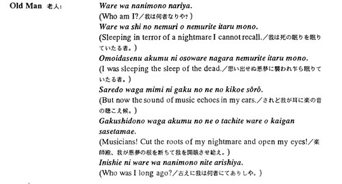
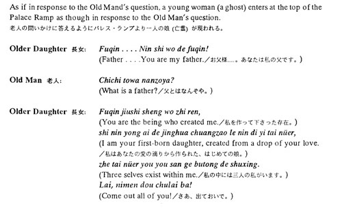
The Sometime Homo's questions, "who am I?" and "what is a father?," equally information technology turns out, are far from rhetorical ones, and the Older Girl's initial reply is insufficient. The Older Girl defines the patriarchal part as one that exerts power, and aspires to such a position and does not refrain from making these desires known throughout the play. At the end of the play, she stabs the Old Human and declares herself "a powerful puppeteer." She presently realizes, even so, that "killing y'all, I become myself"; she becomes the patriarchal figure she wishes to eliminate, and now she has to live with it. The play concludes with neat silence and a sense of solitude.
At the cadre of all iii productions lie the question: "Who am I?" At stake are the artists personal and cultural identities equally the processes of globalisation intensify. The question is equally urgent for Lear every bit it is for contemporary translators, directors, and audiences.
Determination
How many ages hence
Shall this our lofty scene be acted over,
In states unborn and accents however unknown!
—Julius Caesar three.ane.112-114
Cassius' remarks in the scene of Julius Caesar's bump-off are not without prophetic insight. Shakespeare transformed a bully number of sources that enriched his works, and his plays have been translated into a wide range of languages and genres. It is useful to think of translation as a beloved affair involving two equal partners, because it allows us an unimpaired view of the event, and eschews such hierarchical constructs as a superior original and a necessarily lesser derivative. The production and reception of translated works—either literal translation of words into another language (e.g., the Hebrew Bible to the Geneva Bible) or the transformation of meanings into a new course of expression (stage play to picture show noir)—imply double perspectives and accept a significance that goes across the uncomplicated transfer of semantic meanings. A translator is an interpreter of the literary text and its cultural contexts, and a reader of the translation is no less a mediator between many possible worlds and meanings. Contradictory to the purists' anxiety that the proliferation of Shakespeare in translation, whether in mod English or foreign languages, will spell the demise of Shakespeare'south oeuvre, the rise of a global manufacture of translation speaks to the power of Shakespeare'southward words—not bound within the limit of one language and historical period but open to a wide spectrum of interpretive possibilities, a common feature shared by great works of fine art.
Works Cited
Benjamin, Walter (2004). "The job of the translator." Trans. Harry Zohn. In Lawrence Venuti (Ed). The Translation Studies Reader, twond Ed. (pp. 75-86). New York: Routledge.
Burnett, Marker Thornton (2005). "Writing Shakespeare in the global economy." Shakespeare Survey 58: 185-198.
Cantankerous, Francis Due west. (1898). History of the Walloon and Huguenot Church at Canterbury. London: Publications of the Huguenot Club of London.
Derrida, Jacques (1985). "Roundtable on translation." Trans. Peggy Kamuf. In Christie V. McDonald (Ed). The Ear of the Other: Otobiography, Transference, Translation (pp. 91-161) New York: Schocken Books.
Eco, Umberto (2001). Experiences in Translation. Trans. Alastair McEwen. Toronto: University of Toronto Press.
Feng, Xiaogang, dir. (2006). Ye yan (The Banquet). Hong Kong: Huayi Brothers and Media Asia.
Hansen, Niels B. (2008). "'Something is Rotten …'." In Ros King and Paul J. C. M. Franssen (Eds). Shakespeare and State of war. New York: Palgrave Macmillan.
Hoenselaars, Ton (2004). "Introduction: Shakespeare's history plays in U.k. and abroad." In Ton Hoenselaars (Ed). Shakespeare'south History Plays: Performance, Translation and Accommodation in Great britain and Away. (pp. 9-34). Cambridge: Cambridge Academy Printing.
— (2009). "Translation futures: Shakespearians and the foreign text." Shakespeare Survey 62: 273-282.
Jakobson, Roman (2004). "On Linguistic Aspects of Translation." In Lawrence Venuti (Ed). The Translation Studies Reader, 2nd Ed. (pp. 138-143). New York: Routledge.
Kyd, Thomas (2005). The Spanish Tragedy, in Renaissance Drama: An Anthology of Plays and Entertainments, twond Ed. Ed. Arthur F. Kinney. Malden, MA: Blackwell, 143-191.
Lamb, Charles and Mary (1963), Tales from Shakespeare. London: Dent.
Levin, Carole and John Watkins (2009). Shakespeare's Foreign Worlds: National and Transnational Identities in the Elizabethan Age. Ithaca: Cornell University Press.
Morse, Ruth (2006). "Reflections in Shakespeare translation." The Yearbook of English Studies 36.1: 79-89.
Ong, Keng Sen, dir. (1997a). Lear. TheatreWorks, Singapore. Video and documentary with subtitles freely accessible on /
—. (1997b). "Lear: Linking Night and Day." In Lear (stage bill). (p. 5). Tokyo: The Nihon Foundation Asia Center.
Parker, Patricia (2001). "The novelty of dissimilar tongues: Polyglot punning in Shakespeare (and others)." In François Laroque and Franck Lessay (Eds). Esthétiques de la Nouveauté à la Renaissance. (pp. 41-58). Presses de la Sorbonne Nouvelle.
Pestana, Alice (1930). "The king of Portugal's translation of Village (1877)." In Alice Pestana, Alice Pestana 1860-1929: In Memoriam. (pp. 248-263). Madrid: Julio Cosano.
Pfister, Manfred, and Jürgen Gutsch, ed. (2009). William Shakespeare's Sonnets for the First Time Globally Reprinted: A Quartercentenary Anthology with a DVD . Dozwill, Switzerland: Edition Signathur.
Quinn, Aragorn (2011). "Political theatre: two translations of Julius Caesar in Meiji Nihon." In Alexa Huang (Ed). "Shakespeare and Asia," a special upshot of Asian Theatre Journal 28. 1 (Spring): forthcoming.
Ricoeur, Paul (2006). On Translation. Trans. Eileen Brennan. London: Routledge.
Rothwell, Kenneth South. (2004). A History of Shakespeare on Screen: A Century of Movie and Television, 2nd Ed. Cambridge
Shakespeare, William (2005). The Norton Shakespeare, 2nd Ed. Stephen Greenblatt (Ed). New York: W.W. Norton & Co.
Tse, David, dir. (2006). Male monarch Lear. Yellow Earth Theatre (London) and Shanghai Dramatic Arts Centre. Video with subtitles freely attainable on /
Wu, Hsing-kuo, dir. and perf. (2001). Li'er zaici (Lear Is Hither). The Contemporary Legend Theatre, Taipei. Video with subtitles freely accessible on /
crosbyfeavainnince97.blogspot.com
Source: https://globalshakespeares.mit.edu/extra/shakespeare-and-translation-excerpt/
0 Response to "The Question of Reception Martial Arts Fiction in English Translation"
Enregistrer un commentaire